

#21: 5 Steps to Mindful Breathing
And 5 ways it will reduce your stress.


What is Mindful Breathing
I live a stressful life—and if you’re reading this, chances are you do too.
In this guide for beginners, I will show you how to breathe mindfully, and share why it actually relieves stress.
Let’s do this!
The How of Mindful Breathing
There’s no “right” or “wrong” way to engage in mindful breathing; it’s about what works for you.
There’s also no minimum or maximum time required. I do it randomly whenever I’m stressed.
1. Notice and release muscle tension:
My first step is a body scan. Personally, I like to close my eyes (where it’s safe). I usually notice tension in my shoulders, neck, and jaw.
Then, I imagine gravity gently pulling me down, letting my body grow heavy and relaxed.
2. Breathe slowly and deeply:
Inhale… exhale… repeat.
This is the easiest part. You already do it all day every day.
For this exercise, try to regulate your breathing by inhaling through your nostrils and exhaling slowly through your mouth.
3. Pay attention to your breathing:
Notice the pace and depth of your breathing and the sensations that come with it.
Some people find counting to be helpful. I enjoy the 4/7/8 yoga-inspired progression (inhale for 4 seconds, hold for 7, exhale for 8).
Just keep your exhale slower than your inhale to help your body relax.
4. Choose your focus:
This is where the mindfulness starts.
Because thoughts are like text bubbles on annoying group chats—they keep popping up no matter how hard you try to stop them.
Purposefully focus on something neutral, like:
Counting seconds (e.g., 4/7/8),
Thinking “in..… out..…” as you breathe,
Repeating simple affirmations (e.g., “I am calm,” “I am doing my best”),
Noticing the cool air entering your nose and the warm air leaving your mouth,
Or feeling the gentle rise and fall of your belly.
Again, there’s no right or wrong way. You’ll find what works for you with practice.
5. Notice distractions and come back:
Distractions aren’t failure. In fact, random thoughts will pop up (à la annoying group chat). This exercise is simply about deliberately returning to focus.
When thoughts pop up, gently guide your attention back to your target. Visualizing my thoughts floating past like leaves on a stream helps me come back to focus.
I know it’s daunting, but I promise it will become easier with practice!
Remember, it’s not a challenge you can win or lose. It’s about feeling calm and present.
Why it Helps
Now that we’re all feeling zen, let’s nerd into some neuroscience. 🤓
Mindful breathing relaxes us by engaging both the body and mind in ways that directly counter stress.
In other words, it’s a hook-and-jab. Let’s break this down:
Deep breathing:
Deactivates the body’s fight-or-flight system (i.e., sympathetic nervous system),
And activates the rest-and-digest system (i.e., parasympathetic nervous system).
Mindful focus:
Stops rumination, or negative thought patterns, by bringing your focus back to the present.
For extra credit: Nasal inhale and oral exhale help regulate breathing speed and maintain optimal CO₂ levels in your bloodstream (told you we were getting nerdy 🙃).
When to Engage in Mindful Breathing
Unless you’re underwater without a snorkel, it’s pretty much never a bad time to do some mindful breathing!
It’s especially useful during moments like:
When I’m having trouble falling asleep,
Before I speak in public,
When I’m having trouble focusing,
And before starting a demanding task.
The Takeaway
Try it, try it on a train. Try it, try it on a plane… (Sorry—too much Dr. Seuss.)
Whether because it’s trendy, spiritual, or science-y, give mindful breathing a try. It can help you manage life’s stress with a clearer mind and a calmer body.
Worst case scenario, people will think you’re enlightened. Could be worse.
Until next time,
Eli
P.S. Hit the heart below to help me feel appreciated :)
Reader Spotlight 🔎
A section featuring your thoughts and stories. Here is a comment from reader STM about last edition, 3 Reasons to Lie to Yourself:
So well said, Eli, as usual! I definitely do this and encourage others to, but never knew it had scientific validation and fancy names! I just realized that it’s almost like “giving the benefit of the doubt” but to your own situation 😊
Your turn: Please comment below (or to this email) with a thought, story, or reflection for a chance to be featured next!
From the Department of Chill 😎
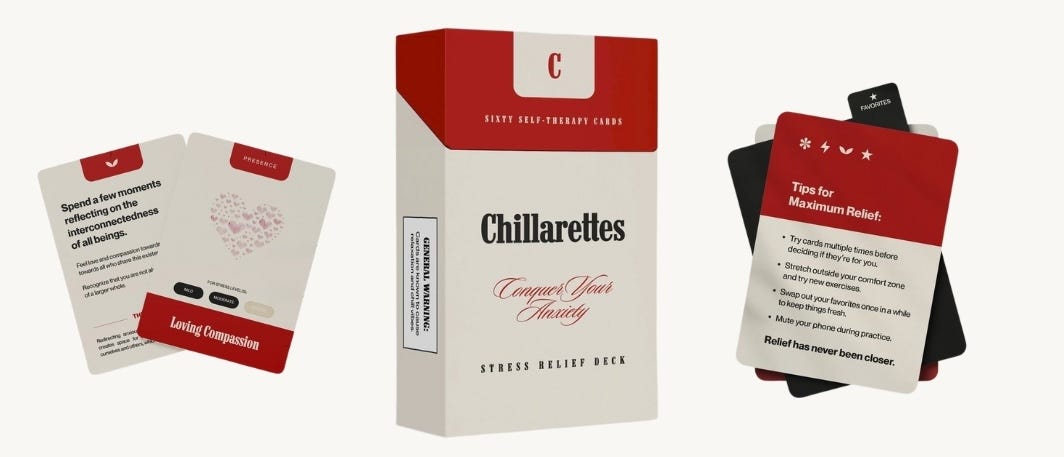
Are you looking for a great holiday gift? Chillarettes is a stress-relief toolkit I created, disguised as a conversation piece.
Use the discount code HOLIDAY15 at checkout for 15% off!
Check it out: Chillarettes.com
The integration of neuroscienc here is what elevates this beyond typical breathing guides. Connecting the parasympathetic activation with the mindfulness component creates a compelling framework for understanding why this works. The 4/7/8 technique specifically targets vagal tone, which has measurable effects on heart rate variability. Framing distractions as a normal part of the practice rather than failure is crucial for beginers who often abandon meditation techniques when their mind wanders.
I like the emphasis on exhaling more slowly than the inhale; I've found that to be a game-changer for me where other deep-breathing approaches like box breathing have fallen flat.